
Market Update — Mid-Year 2026
July 27, 2026
A Tale of Two Quarters
The first half of 2026 was a tale of two quarters. The year opened on a confident note, with both stock and bond markets carrying forward the momentum of 2025. That changed abruptly in late February, when conflict between the United States and Iran disrupted shipping through the Strait of Hormuz, which carries roughly one-fifth of the world’s oil. Energy prices spiked, oil surged above US$100 a barrel, and markets sold off sharply through March.
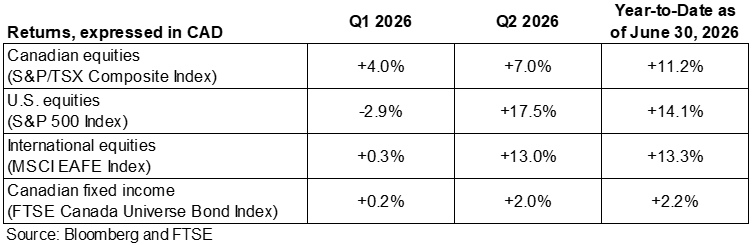
The second quarter told a very different story. As diplomatic efforts produced a (now failed) ceasefire and energy prices eased, equities staged a strong recovery. By mid-June the S&P 500 had set fresh record highs and Canada’s S&P/TSX Composite pushed into record territory. Despite the volatility, most major equity markets entered the second half of the year higher, with the S&P 500 up roughly 14% and the TSX up roughly 11% year-to-date.
Fixed Income and Interest Rates
Shift in expectations
Perhaps the biggest change since January has been in the outlook for interest rates. Coming into 2026, markets broadly expected the U.S. Federal Reserve to reduce interest rates two or three times (for a total of 75 basis points), over the course of the year as inflation continued to cool. The energy shock from the Iran conflict upended that thinking. With U.S. inflation climbing to 4.2% year-over-year in May (its highest reading in three years), anticipated interest rate reductions were priced out of the fixed income market entirely, as yields moved higher. By mid-June, the conversation had flipped from “how many cuts?” to “could the next move be a hike?”
The U.S. Federal Reserve has held its benchmark rate steady at 3.50% to 3.75% through four meetings this year, including the first under new Chair Kevin Warsh. The Fed’s June projections turned notably more hawkish, with the median view now pointing to a slightly higher rate by year-end and several U.S. Fed officials expecting at least one increase. The Bank of Canada, meanwhile, has kept its policy rate at 2.25%, balancing the same energy related inflation pressures against more muted economic growth. For bond investors, the takeaway is that the higher-yield environment of the past few years looks set to persist longer than many anticipated just six months ago.
Equity Markets
A few themes defined equity markets in the first half of 2026. Market leadership broadened beyond the handful of mega-cap technology names that drove returns over the previous three years. Energy and other commodity-linked sectors surged alongside higher oil prices. Improved market breadth was evident in the outperformance of the S&P 500 Equal Weight Index relative to its cap-weighted counterpart, reflecting a broader distribution of gains across the market. Here is how the picture looked across the major regions.
Canada
The TSX’s heavy weighting in energy, materials and financials worked in its favour this year. The energy sector led the index as elevated oil prices benefitted large Canadian producers and pipeline operators.
The move between the first and second quarters was modest for Canadian equities, especially against the sharp swings in U.S. and international markets. Gold led early in the year on dollar weakness, ETF inflows, and rate-cut expectations, while energy names benefited directly from the spike in oil prices after the Strait of Hormuz disruption. As tensions eased in the second quarter and the ceasefire took hold, that early leadership cooled. Oil retreated and gold eased from its highs, though gold held above US$4,000 an ounce for most of the year. The index continued to advance as gains broadened across the rest of the market. Financials drove most of the index’s return in the second quarter, with industrials being the second-largest contributor, helping the index continue to advance even as materials and energy declined.
United States
The U.S. market saw a notable first-quarter decline followed by a strong second-quarter recovery to new highs. Prior to 2026, for three straight years, the “Magnificent Seven” (Nvidia, Apple, Microsoft, Alphabet, Amazon, Meta and Tesla) drove the bulk of market returns. In 2026, that leadership fractured. As a group, these seven names gained just 1.3% in Canadian dollar terms in the first half of the year, even as the broader S&P 500 rose roughly 14%. It was a striking reversal after years of dominance.
The dispersion within the Magnificent Seven was wide. Alphabet has outperformed on strong demand for its AI products, while Microsoft has lagged meaningfully on concerns that its heavy AI spending has not yet translated into proportional revenue growth. At the same time, semiconductor stocks have soared, with the closely watched PHLX Semiconductor Index posting one of its best years in decades.
Industrials, energy, and technology were the top performing sectors in the first half of the year. Energy and technology were lifted by elevated oil prices and the strength of semiconductor stocks. Industrials were supported by a pick-up in manufacturing activity and by growing demand from the AI buildout, which requires vast amounts of power, construction, and heavy equipment.
International
International developed markets shared many of the same themes – an energy-led first quarter and a broader market recovery thereafter. In the first quarter, performance was concentrated in energy producers and materials companies that benefited directly from higher oil and commodity prices (including gold). The defence sector also continued to benefit from rising European military budgets.
The second quarter saw market leadership broaden as the ceasefire in the Middle East took hold and energy prices eased. This resulted in energy and materials companies handing back some of their Q1 gains, while financials, industrials and technology drove overall index performance. Defence remained a leading sector across both quarters, as European governments continue to deploy significant fiscal firepower toward defence and infrastructure against a backdrop of higher geopolitical risk and ongoing conflicts.
Themes We’re Watching
Artificial intelligence: boom, or bubble?
Artificial intelligence is certainly the most pervasive market theme. The largest technology companies are collectively expected to spend over US$700 billion on AI infrastructure in 2026 – approximately double compared to 2025. To put that spending in perspective, the entire U.S. defence budget is approximately $1 trillion. The companies supplying the hardware (semiconductors and memory) have been the primary beneficiaries of this spending. However, much of the demand for AI chips is concentrated among a small number of large customers, which adds a layer of risk if capital spending slows among any of them. Eventually, the large technology companies will need to see a return on their significant investments, but for now it appears to be an arms race with the primary goals being to defend their existing business models and to own a dominant share of the future AI industry.
A historic wave of new listings
Related to the AI story is a significant wave of initial public offerings. SpaceX listed in June at a valuation near US$1.75 trillion (the largest IPO in history) and two of the most prominent AI companies, Anthropic and OpenAI, are expected to follow, with debuts anticipated later in 2026 and into 2027. This matters to investors because companies of this size are likely to be added to benchmarks such as the S&P 500. Because these indices are weighted by market value, adding a handful of trillion-dollar names can further concentrate returns in a small number of very large stocks, deepening a trend that already exists in the U.S. market.
The CUSMA review and the future of North American trade
July 1st marked the first mandatory six-year review of the Canada-United States-Mexico Agreement (CUSMA), and rather than simply extending the deal, the U.S. administration opted not to renew it in its current form. That decision keeps the agreement in force but triggers a series of annual reviews and starts a longer-term countdown that could see it expire as soon as 2036 if no extension is reached. Negotiations are now underway, with the U.S. pursuing separate bilateral discussions with Canada and Mexico and using tariffs on autos, steel and aluminum as leverage. The stakes for Canada are high as nearly all of Canada’s exports currently qualify under CUSMA. The outcome ranges from a straightforward extension that preserves the status quo to a more difficult renegotiation that raises trade costs and weighs on export-sensitive parts of the economy. The Bank of Canada has flagged this as one of the key risks to its outlook. It appears that trade-related uncertainty is likely to linger for some time.
As of July 20th, the U.S. announced a new 50% tariff on a wide range of Canadian products, set to take effect on August 19th. This marks an escalation in the trade dispute and may be an attempt by the Trump administration to gain further leverage during ongoing CUSMA negotiations.
The U.S. midterm elections
Looking further out, U.S. politics will move into focus as the midterm elections approach in early November, with all 435 House seats and roughly a third of the Senate on the ballot. Historically, the President’s party has typically lost ground in midterm years. Current forecasts predict that control of the House will change hands to the Democrats while the Senate could be a tight race. Either way, the most likely result is some form of divided government, which tends to slow the pace of major legislation. For markets, that is not necessarily a negative, however, as power being more evenly split lowers the odds of abrupt, large scale policy changes.
Keeping Perspective
Despite this year’s volatility, investors have enjoyed historically strong absolute returns over the past three to four years. Periods like this can influence expectations and behaviour, and it is important to stay grounded and be aware of common behavioural biases:
- Recency bias — assuming that the recent past, good or bad, will simply continue. Strong recent returns are not a forecast of future returns.
- Overconfidence — the tendency to overestimate investment knowledge or skills, often reinforced by experiencing a period of strong returns. This can lead to unintended excessive risk-taking or under-diversification.
- Fear of missing out (FOMO) — chasing whatever market or trend has risen the most, driven by the fear of “being left behind”. FOMO can result in entering an investment near peak valuation levels and being exposed to significant downside.
A disciplined investment plan is one of the most effective tools for guarding against these (and other) behavioural biases. By setting a long-term strategy and a target asset allocation in advance, it provides a steady framework for decision-making that is far less susceptible to the emotions of the moment. When markets swing sharply in either direction, that structure helps keep short-term reactions from derailing well-considered, long-term goals.
Download this newsletter as a PDF.
About Us
Disciplined. Compassionate. Effective.
Quadrant Private Wealth is an independent, comprehensive, integrated wealth management firm committed to your financial well-being and peace of mind. We take the time to understand your complete financial picture. We tie all of your information together, including tax planning, to paint a picture of what your financial future could look like. And we aim to earn your complete confidence in the process.
Quadrant Private Wealth
Suite 720, One Lombard Pl
Winnipeg, MB
Ph: (204) 944-8124
email: inquiries@quadrantprivate.com
web: www.quadrantprivate.com
Disclaimer
This report may not be redistributed, retransmitted or disclosed, in whole or in part, or in any form or manner, without the express written consent of Quadrant Private Wealth ("Quadrant"). Any unauthorized use or disclosure is prohibited. The information herein was obtained from various sources believed to be reliable but Quadrant does not guarantee its accuracy. Neither Quadrant nor any director, officer or employee of Quadrant accepts any liability whatsoever for any direct, indirect or consequential damages or losses arising from any use of this report or its content. The opinions, estimates and projections contained in this report are as of the date indicated and are subject to change without notice. Certain of the statements may contain forward-looking statements which involve known and unknown risk, uncertainties and other factors which may cause the results, performance or achievements of the company, or industry results, to be materially different from any future results, performance or achievements expressed or implied by such forward-looking statements. Past performance is not indicative of future performance. The content of this report is intended for information purposes only and does not constitute an offer to buy or sell our products or services.
